
Hip pain while walking is usually caused by hip osteoarthritis, bursitis, tendinitis, labral tears, or muscle strain. It often worsens with weight-bearing activity and improves with rest. Persistent pain, stiffness, limping, or reduced range of motion should be evaluated by an orthopedic surgeon to rule out joint damage that needs treatment.
Hip pain during walking typically results from wear-and-tear conditions like osteoarthritis, soft-tissue issues such as bursitis or tendinitis, or structural problems like labral tears and hip impingement. Risk increases with age, obesity, prior injury, and repetitive strain. Diagnosis involves a physical exam, gait assessment, and imaging such as X-ray or MRI. Mild cases often respond to physiotherapy, weight management, and activity changes, while advanced arthritis or joint damage may require injections, arthroscopy, or hip replacement surgery. Residents of Raghuvanahalli, JP Nagar, Jayanagar, Banashankari, and nearby areas can consult an orthopedic specialist for an accurate diagnosis and a personalised treatment plan.
If every step sends a sharp twinge through your hip, you’re not alone. Hip pain while walking is one of the most common reasons adults across Raghuvanahalli visit an orthopedic clinic, and it can stem from anything as simple as a tight muscle to something more serious like advanced arthritis. Ignoring it rarely helps — pain that lingers for more than a couple of weeks usually signals an underlying joint problem that needs proper evaluation. This guide explains why hip pain occurs during walking, how it is diagnosed, and when it is time to consult a Hip Replacement Surgeon in Raghuvanahalli like Dr. Vijay Kulkarni for lasting relief.
Why Hip Pain Occurs While Walking
Every time you take a step, your hip joint bears several times your body weight. Pain appears when the smooth cartilage lining the joint wears down, when the surrounding muscles and tendons are overworked, or when a nearby nerve gets irritated. Because the hip connects your spine, pelvis, and leg, pain here can also come from problems outside the joint itself, such as the lower back.
Anatomy of the Hip Joint
The hip is a ball-and-socket joint: the rounded head of the thighbone (femur) fits into a socket in the pelvis called the acetabulum. A ring of cartilage called the labrum deepens this socket and cushions movement, while a network of muscles, tendons, and ligaments keeps the joint stable during walking, climbing stairs, and standing.
Common Causes of Hip Pain While Walking
Hip Osteoarthritis
The protective cartilage gradually wears away, causing bone-on-bone friction. It is the leading cause of hip pain in adults over 50 and typically worsens with activity.
Hip Bursitis
Inflammation of the fluid-filled sac (bursa) on the outer hip causes tenderness on the side of the hip, especially when walking or lying on that side.
Tendinitis
Overuse inflames the tendons around the hip, common among runners, cyclists, and people who suddenly increase activity levels.
Hip Labral Tear
A tear in the cartilage rim of the socket can cause catching, clicking, or a locking sensation during walking or pivoting.
Muscle Strain
Overstretched hip flexors, glutes, or adductors from sudden movement, poor posture, or overuse can cause sharp or aching pain.
Hip Impingement (FAI)
Extra bone growth on the femoral head or socket causes abnormal contact, restricting motion and irritating the joint over time.
Hip Fractures
A sudden, severe pain after a fall — especially in older adults with weaker bones — requires emergency orthopedic care.
Avascular Necrosis
Reduced blood supply to the femoral head causes bone tissue to weaken and eventually collapse if untreated.
Sciatica Referred Pain
A pinched nerve in the lower spine can send pain radiating into the hip and buttock, mimicking a joint problem.
Inflammatory Arthritis
Conditions such as rheumatoid arthritis cause the joint lining to swell, leading to stiffness, warmth, and pain during movement.
Risk Factors
- Advancing age and natural cartilage wear
- Being overweight, which increases load on the hip joint
- Previous hip injury, fracture, or surgery
- Repetitive high-impact sports or occupations
- A sedentary lifestyle with weak hip and core muscles
- Family history of arthritis or joint disease
Symptoms That Should Not Be Ignored
- Pain lasting longer than two weeks
- A noticeable limp while walking
- Pain that wakes you up at night
- Swelling, warmth, or redness around the hip
- Clicking, catching, or locking sensations
- Sudden severe pain after a fall or twist
Diagnosis by an Orthopedic Specialist
An accurate diagnosis combines a detailed conversation with hands-on and imaging assessments.
Medical History
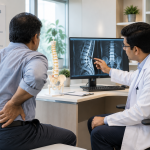
The surgeon reviews when the pain started, its pattern, prior injuries, and how it affects daily activities like walking or climbing stairs.
Physical Examination
Range of motion, tenderness, strength, and joint stability are checked to narrow down the likely cause.
Gait Analysis
Observing how you walk helps identify limping patterns, muscle weakness, or compensations linked to the hip.
Imaging Tests
- X-ray — shows joint space narrowing, bone spurs, and fractures
- MRI — detects labral tears, cartilage damage, and soft-tissue injury
- CT Scan — provides detailed bone imaging for complex fractures
- Ultrasound — used selectively to assess bursitis or fluid collections
Home Remedies That May Help
- RICE Method — rest, ice, compression, and elevation for acute flare-ups
- Walking modifications — shorter strides and supportive footwear reduce strain
- Heat vs cold therapy — heat eases stiffness, cold reduces acute inflammation
- Stretching exercises — gentle hip flexor and glute stretches improve flexibility
- Hip strengthening exercises — supports the joint and reduces load on cartilage
- Weight management — even modest weight loss meaningfully reduces hip stress
- Lifestyle changes — pacing activity and avoiding prolonged standing
- Proper footwear — cushioned, supportive shoes reduce impact while walking
- Pain medications — over-the-counter options may offer short-term relief; a doctor should guide their appropriate use
Physiotherapy for Hip Pain
A structured physiotherapy program builds strength in the muscles that support the hip, improves flexibility, and corrects walking patterns that place uneven stress on the joint. It is often the first line of treatment for mild to moderate hip pain.
Non-Surgical Treatments
- Activity modification to avoid movements that aggravate pain
- Physiotherapy for targeted strengthening and mobility
- Medications to manage pain and inflammation
- Bracing or walking aids, where appropriate, to offload the joint
Injection Therapies
Corticosteroid Injections
These reduce inflammation directly in the joint, offering temporary relief for arthritis or bursitis flare-ups.
PRP Therapy (Overview)
Platelet-rich plasma uses concentrated growth factors from the patient’s own blood to support tissue healing in select cases.
Hyaluronic Acid Injections
These supplement the joint’s natural lubricating fluid, which may ease movement in mild to moderate arthritis.
When Surgery Becomes Necessary
Surgery is generally considered when pain persists despite conservative treatment, or when imaging shows significant joint damage.
Hip Arthroscopy
A keyhole procedure used to repair labral tears or address impingement, preserving the natural joint wherever possible.
Partial Hip Replacement
Replaces only the damaged femoral head, most often used for certain hip fractures in older patients.
Total Hip Replacement
Both the socket and femoral head are replaced with implants, relieving pain from advanced arthritis and restoring mobility.
Robotic Hip Replacement Surgery
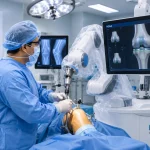
Robotic-assisted technology helps map the joint precisely, supporting accurate implant positioning, better alignment, and a smoother recovery.
Recovery Timeline After Hip Treatment
- Hip arthroscopy — most patients resume light activity within 2–4 weeks and full activity by 6–8 weeks
- Total or robotic hip replacement — walking with support within 1–2 days, most daily activities by 6 weeks, and continued improvement over 3–6 months
- Non-surgical care — noticeable improvement is often seen within 4–6 weeks of consistent physiotherapy
Prevention Tips
- Maintain a healthy body weight to reduce joint load
- Strengthen hip, glute, and core muscles regularly
- Warm up properly before sports or exercise
- Choose supportive, well-cushioned footwear
- Avoid prolonged sitting or standing in one position
- Seek evaluation early for any new hip or groin pain
When to Consult a Hip Replacement Surgeon in Raghuvanahalli
You should not wait if hip pain persists despite rest, if it disrupts your sleep, if walking or climbing stairs has become difficult, or if you notice a visible limp or deformity. Early diagnosis prevents further joint damage and widens your treatment options. Dr. Vijay Kulkarni’s Encore Speciality Clinics in Doddakallasandra is easily accessible for patients from Raghuvanahalli, JP Nagar, Jayanagar, Banashankari, Uttarahalli, Kanakapura Road, and Vajrahalli, with a second location at KIMS Hospitals, Electronic City.
Comparison Tables
Hip Arthritis vs Hip Bursitis
| Hip Arthritis | Hip Bursitis |
| Deep groin or thigh pain | Pain on the outer side of the hip |
| Worsens gradually over months to years | Can appear suddenly with overuse |
| Stiffness, especially in the morning | Tenderness when lying on the affected side |
| Often needs imaging to confirm cartilage loss | Often diagnosed by physical exam alone |
Temporary Hip Pain vs Serious Hip Condition
| Temporary Hip Pain | Serious Hip Condition |
| Eases with rest within a few days | Persists beyond two weeks despite rest |
| No swelling or limping | Swelling, limping, or locking present |
| Follows a specific activity or overuse | Occurs even during normal daily movement |
| No history of trauma | Follows a fall, injury, or sudden twist |
Home Remedies vs Medical Treatment
| Home Remedies | Medical Treatment |
| Best for mild, short-term discomfort | Needed for persistent or worsening pain |
| RICE, stretching, weight management | Physiotherapy, injections, or surgery |
| No professional diagnosis involved | Includes examination and imaging |
| Limited long-term joint protection | Addresses the underlying cause directly |
Physiotherapy vs Hip Replacement Surgery
| Physiotherapy | Hip Replacement Surgery |
| Suited to mild-to-moderate joint wear | Suited to advanced arthritis or joint damage |
| Non-invasive, gradual improvement | Surgical, faster and more complete relief |
| Focuses on strength and mobility | Replaces damaged joint surfaces |
| May be combined with other treatments | Recommended when conservative care fails |
Traditional vs Robotic Hip Replacement
| Traditional Hip Replacement | Robotic Hip Replacement |
| Manual implant positioning based on surgeon judgment | Computer-guided mapping supports precise implant placement |
| Standard recovery protocols | Often supports faster, smoother rehabilitation |
| Well-established, widely available technique | Advanced technology for improved alignment accuracy |
| Suitable for most patients | Particularly beneficial for complex joint anatomy |
Frequently Asked Questions
Why does my hip hurt only when I walk?
Walking loads the hip joint repeatedly, so conditions like early arthritis, bursitis, or tendinitis often show up only during movement rather than at rest. If the pain is mild and occasional, it may be muscular. Persistent or worsening pain during walking should be evaluated by an orthopedic surgeon to identify the exact cause.
Can hip pain while walking go away on its own?
Mild strains or overuse pain can improve with rest, stretching, and activity modification within a few days to weeks. However, pain caused by arthritis, labral tears, or impingement usually does not resolve on its own and tends to worsen without proper diagnosis and treatment.
Is hip pain while walking always a sign of arthritis?
No. While osteoarthritis is a common cause, walking-related hip pain can also come from bursitis, tendinitis, muscle strain, labral tears, or even referred pain from the lower back. An orthopedic evaluation helps pinpoint the actual cause before assuming arthritis.
What tests are used to diagnose hip pain?
Diagnosis typically starts with a medical history and physical examination, followed by gait analysis. Imaging such as X-rays identifies bone changes, while MRI is used to assess cartilage, labral, and soft-tissue injuries. CT scans and ultrasound are used selectively when needed.
When is hip replacement surgery recommended?
Hip replacement is generally recommended when pain from advanced arthritis or joint damage significantly limits daily activities and does not respond to physiotherapy, medications, or injections. Imaging showing substantial cartilage loss or joint deformity also supports this recommendation.
How long does recovery take after hip replacement surgery?
Most patients begin walking with support within 1–2 days after surgery. Daily activities typically resume within about 6 weeks, with continued strength and mobility improvements over 3–6 months, depending on the individual’s health and rehabilitation program.
Is robotic hip replacement better than traditional surgery?
Robotic-assisted hip replacement uses computer-guided mapping to support more precise implant positioning and alignment, which can contribute to a smoother recovery. Traditional surgery remains a well-established and effective option; your surgeon can advise which approach suits your anatomy.
Can I prevent hip pain from returning after treatment?
Maintaining a healthy weight, strengthening the hip and core muscles, wearing supportive footwear, and avoiding prolonged inactivity all help protect the joint long term. Regular follow-up with your orthopedic surgeon also helps catch any recurring issues early.
Conclusion
Hip pain while walking can range from a minor muscle strain to a sign of advancing arthritis or joint damage, and the right treatment depends entirely on an accurate diagnosis. Home care and physiotherapy help many mild cases, but persistent pain, limping, or stiffness deserve a professional evaluation rather than guesswork. As an experienced Hip Replacement Surgeon in Raghuvanahalli, Dr. Vijay Kulkarni offers thorough diagnosis, non-surgical care, and advanced robotic hip replacement options tailored to each patient’s needs.
Call to Action
If hip pain is affecting your walk, don’t wait for it to worsen. Patients from Raghuvanahalli, JP Nagar, Jayanagar, Banashankari, Uttarahalli, Kanakapura Road, Doddakallasandra, and Vajrahalli can book a consultation with Dr. Vijay Kulkarni for an expert diagnosis and a personalised hip pain treatment plan. Call +91 78996 24345 or +91 88675 17340 to schedule your visit at Encore Speciality Clinics, Doddakallasandra.