If you’ve been living with chronic knee pain, stiffness, or swelling that limits your daily activities, you may have started researching treatment options. Many patients exploring robotic knee replacement in Electronic City come across two terms: robotic-assisted surgery and traditional knee replacement. Both are meant to relieve pain and restore movement, but they use different techniques to get there.
It’s important to understand from the start that robotic-assisted knee replacement does not mean a robot performs the surgery on its own. The orthopedic surgeon remains fully in control of the procedure. Robotic technology, where used, simply provides additional planning and positioning support during surgery.
This raises a natural question for anyone comparing options: is robotic knee replacement actually different from traditional knee replacement, and which approach might suit your situation? This guide breaks down both techniques so you can have an informed conversation with your orthopedic surgeon.
Robotic vs Traditional Knee Replacement
Robotic-assisted knee replacement uses computer-guided technology to help the surgeon plan implant positioning and bone alignment with added precision. Traditional knee replacement relies on the surgeon’s manual technique and standard instrumentation. Both aim to relieve arthritis pain, and the right choice depends on your knee anatomy, arthritis severity, and surgeon assessment.
Understanding Knee Replacement Surgery
Knee replacement, or knee arthroplasty, is a surgical procedure used to treat advanced knee arthritis or joint damage that has not responded to conservative treatments such as medication, physiotherapy, or lifestyle changes. During the procedure, damaged cartilage and bone are removed and replaced with an artificial implant designed to restore joint function.
Patients typically consider knee replacement when they experience:
- Persistent knee pain that limits walking or standing
- Stiffness that affects daily movement
- Swelling that does not improve with rest
- Difficulty climbing stairs or getting up from a chair
- Reduced quality of life due to knee problems
What Is Traditional Knee Replacement?
Traditional knee replacement, also called conventional total knee replacement, has been performed successfully for decades. In this approach, the surgeon uses manual instruments and their clinical experience to prepare the bone surfaces, align the joint, and position the implant.
Traditional knee replacement:
- Relies on the surgeon’s hands-on technique and judgment
- Uses standard surgical instruments and guides
- Is a well-established procedure with a long track record
- Remains a suitable option for many patients
Traditional surgery continues to deliver good outcomes for a large number of patients and is not considered outdated. It remains a core treatment option in orthopedic practice.
What Is Robotic-Assisted Knee Replacement?
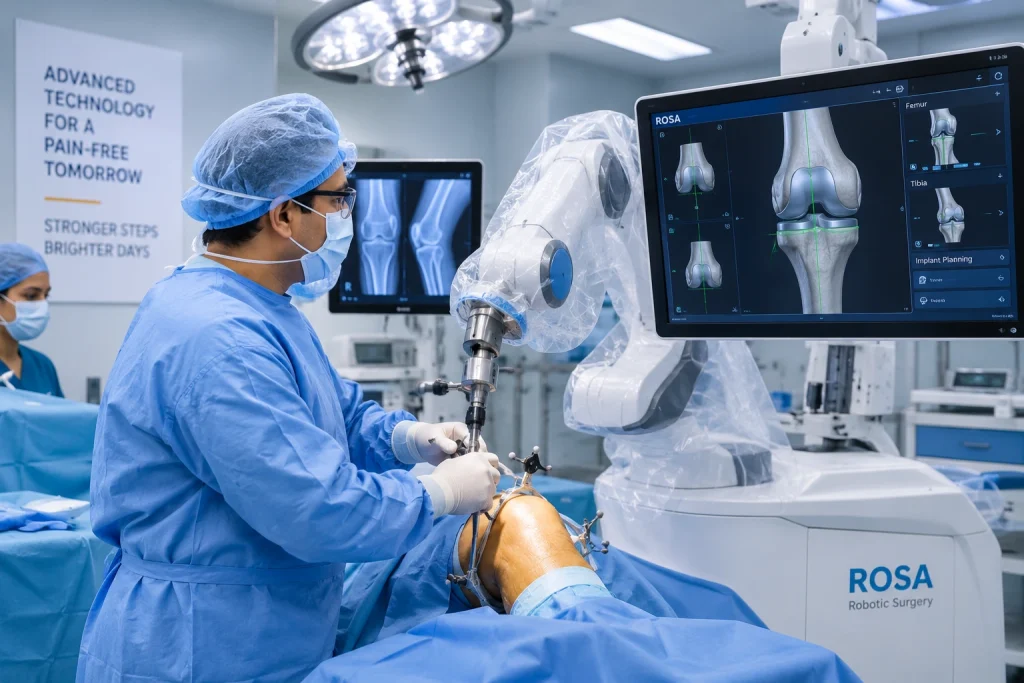
Robotic-assisted knee replacement uses a computer-guided system to support the surgeon during specific steps of the procedure, such as pre-surgical planning, bone alignment, and implant positioning. The system typically works from a 3D model of the patient’s knee, allowing the surgeon to plan the procedure with additional data before making any incisions.
It’s important to clarify a common misconception: the robotic system does not operate independently. The orthopedic surgeon performs the surgery, and the technology serves as a planning and guidance tool. Depending on the specific system used, robotic assistance may help with:
- Mapping the patient’s unique knee anatomy
- Planning implant size and position
- Guiding bone preparation within a planned range
- Supporting soft-tissue balance assessment
Robotic Knee Replacement vs Traditional Knee Replacement: Key Differences
| Aspect | Traditional Knee Replacement | Robotic-Assisted Knee Replacement |
| Surgical planning | Based on surgeon’s assessment and standard imaging | Often supported by 3D imaging and computer modeling |
| Technique | Manual instrumentation | Surgeon-controlled, technology-assisted instrumentation |
| Precision tools | Standard alignment guides | Additional computer-assisted guidance |
| Track record | Decades of established outcomes | Growing body of clinical experience |
| Surgeon’s role | Fully hands-on throughout | Fully hands-on, with added planning support |
| Suitability | Wide range of patients | Depends on anatomy, technology access, and case complexity |
Both approaches share the same surgical goal: removing damaged joint surfaces and placing a well-positioned implant to restore function.
Is Robotic Knee Replacement Better Than Traditional Surgery?
This is one of the most common questions patients ask, and the honest answer is that it depends on the individual case. Robotic-assisted technology is a tool that may support certain aspects of surgical planning, but it does not replace the surgeon’s skill, judgment, and experience, which remain central to a successful outcome.
Outcomes after any knee replacement depend on multiple factors, including:
- Patient selection and overall health
- Severity and pattern of arthritis
- Surgical technique and experience
- Implant choice
- Post-surgical rehabilitation and physiotherapy
- Adherence to recovery guidelines
Neither approach can guarantee a specific outcome, and no responsible orthopedic surgeon should claim otherwise. The most appropriate technique is determined after a thorough clinical evaluation.
Who May Benefit From Robotic-Assisted Knee Replacement?
Robotic assistance may be considered for certain patients, such as those with specific anatomical variations or alignment challenges, where additional pre-surgical mapping could support planning. However, suitability is always case-specific and should be discussed during an orthopedic consultation rather than assumed based on general information online.
Factors your surgeon may evaluate include:
- Degree and pattern of knee arthritis
- Bone quality and joint alignment
- Previous knee injuries or surgeries
- Overall health and medical history
- Available technology and surgical infrastructure
Is Robotic Knee Replacement More Expensive?
Robotic-assisted procedures can involve additional costs related to the technology and equipment used. Traditional knee replacement is generally more widely available and may involve different cost considerations. Exact costs vary based on the hospital, surgeon, implant type, and individual case complexity, so it’s best to discuss detailed pricing directly during your consultation.
How Long Does Knee Replacement Recovery Take?
Recovery timelines vary from patient to patient, but a general pattern often includes:
- First few days: Hospital monitoring and initial mobilization with support
- First 2–6 weeks: Physiotherapy focused on walking and regaining knee movement
- 6 weeks to 3 months: Gradual return to daily activities with continued therapy
- 3–6 months and beyond: Continued strength building and functional improvement
Recovery speed depends on factors such as age, general health, pre-surgery muscle strength, and how consistently a patient follows the physiotherapy plan, regardless of which surgical technique is used.
Choosing Between Robotic and Traditional Knee Replacement
There is no universal answer to which technique is right for every patient. The decision should be based on:
- A detailed clinical examination
- Imaging and assessment of joint damage
- Your general health and lifestyle needs
- A discussion with your orthopedic surgeon about the pros, limitations, and expectations of each approach
If you’re researching knee replacement surgery in Electronic City, it’s worth scheduling an in-person evaluation rather than relying solely on online comparisons, since every knee is different.
Knee Replacement Care Near Electronic City
Patients from Electronic City and surrounding areas such as Bommasandra, Hosa Road, Singasandra, Begur, Bannerghatta Road, Hulimavu, Chandapura, and Attibele often look for accessible, experienced orthopedic care closer to home. Dr. Vijay Kulkarni, an orthopedic surgeon in Bangalore, provides consultation and treatment for knee arthritis, robotic and traditional knee replacement, and related joint conditions, helping patients understand which option may suit their specific case.
If you’re searching for robotic knee replacement near me Electronic City, an in-person consultation is the most reliable way to get a personalized assessment.
Frequently Asked Questions
Does a robot perform the knee replacement surgery?
No. The orthopedic surgeon performs the surgery. Robotic systems, where used, assist with planning and guidance during specific steps.
Is robotic knee replacement suitable for everyone?
Not necessarily. Suitability depends on individual anatomy, arthritis severity, overall health, and surgeon assessment.
Is traditional knee replacement still effective?
Yes. Traditional knee replacement remains an established and widely used treatment option with decades of clinical experience behind it.
How do I know which option is right for me?
An orthopedic evaluation, including examination and imaging, helps determine the most appropriate approach for your knee condition.
Final Thoughts
Both robotic-assisted and traditional knee replacement aim to relieve pain and restore mobility for patients with advanced knee arthritis. Robotic technology may offer additional planning support in certain cases, but it does not replace surgical skill, and traditional techniques continue to deliver reliable outcomes for many patients.
If chronic knee pain is affecting your daily life, the most important step is a professional orthopedic evaluation. This allows your surgeon to assess your specific condition and recommend an approach — robotic-assisted or traditional — that best fits your needs.
This article is for general educational purposes and does not replace professional medical advice. Please consult an orthopedic surgeon for diagnosis and personalized treatment recommendations.