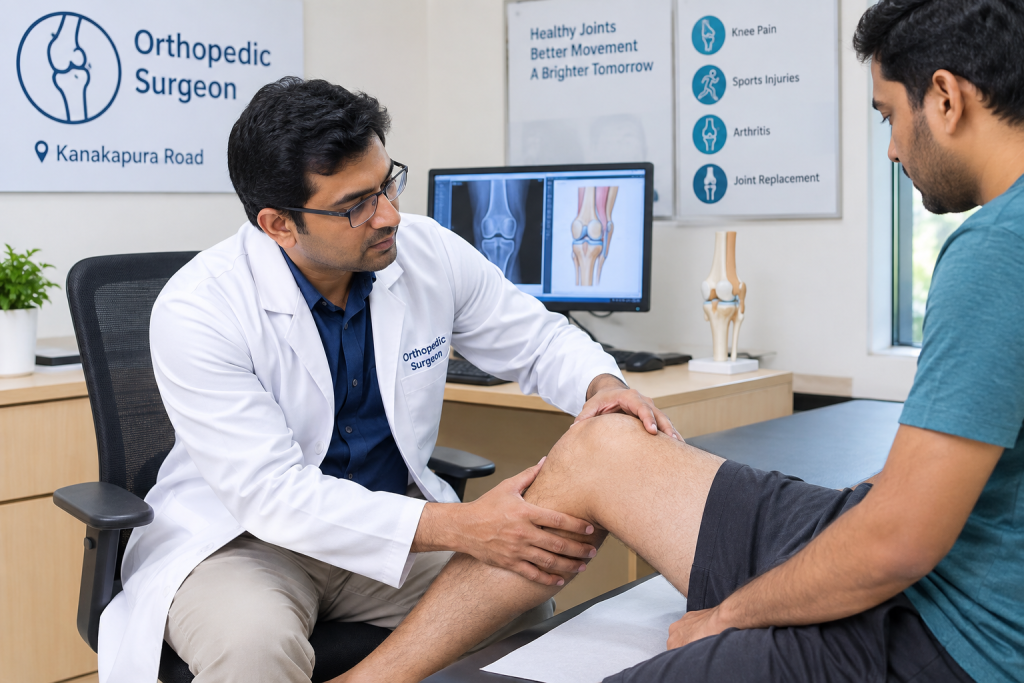
Does your knee hurt when you walk, climb stairs, exercise, or stand for long? You are not alone. Many people around South Bangalore look for an orthopedic surgeon in Kanakapura Road because knee pain has started to affect daily life.
Knee pain has many possible causes. These range from temporary strain and sports injuries to osteoarthritis, ligament problems, and cartilage damage. Not every case needs surgery. The right treatment depends on the cause, severity, age, activity level, overall health, and what you need your knee to do.
What are the common causes of knee pain?
Knee pain is commonly caused by osteoarthritis, sports injuries such as ligament or meniscus tears, overuse, muscle weakness, cartilage damage, tendon problems, bursitis, and previous injuries. Some inflammatory conditions can also affect the knee. An orthopedic examination helps identify the actual cause. (42 words)
What Is Knee Pain?
Knee pain means discomfort in or around the knee joint. The knee is a complex joint made up of:
- Bones (thigh bone, shin bone, and kneecap)
- Cartilage, the smooth cushion on bone ends
- Menisci, the shock-absorbing pads between the bones
- Ligaments, which keep the knee stable
- Tendons, which connect muscle to bone
- Muscles, which move and support the joint
- Joint lining, which produces lubricating fluid
Pain can come from injury, inflammation, degeneration, overuse, or a problem in any of these structures.
Common Causes of Knee Pain
- Osteoarthritis: Age-related wear and changes in the joint can cause pain, stiffness, and reduced movement.
- Sports injuries: These can involve the ACL, PCL, MCL, LCL, meniscus, or tendons, often after twisting, landing, or sudden impact.
- Overuse and repetitive stress: Repeated running, climbing, squatting, or kneeling can irritate the knee over time.
- Muscle weakness or imbalance: Weak hip, thigh, or knee muscles can change how the knee moves and loads.
- Previous injury: Old injuries can sometimes contribute to ongoing knee problems.
- Cartilage problems: When the cushioning surface is damaged or thinned, movement can become painful or feel rough.
- Bursitis or tendon problems: Inflammation around the knee can cause localized pain, often linked to activity.
- Other medical conditions: Some inflammatory or systemic conditions can affect joints.
Symptoms alone cannot confirm the cause. Only an examination can do that.
What Are the Symptoms of Knee Problems?
Symptoms vary with the underlying condition. Common ones include:
- Knee pain, swelling, and stiffness
- Difficulty bending or straightening the knee
- Pain while walking, climbing stairs, or after sitting for a long time
- Difficulty standing for long periods
- Clicking or grinding sensations
- A feeling that the knee may give way
- Reduced range of motion
- Difficulty taking part in sports
When Is Knee Pain an Emergency?
Seek prompt medical assessment, and do not self-treat, if you have:
- A major injury with severe pain
- Obvious deformity or a suspected fracture or dislocation
- Inability to bear weight after significant trauma
- Rapid, severe swelling after an injury
- An open wound around the knee
- Numbness or loss of sensation
- A pale, blue, or unusually cold foot
- Severe, uncontrolled pain
- Fever with a hot, swollen, painful knee
How Is Knee Pain Diagnosed?
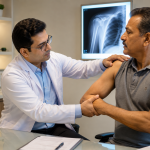
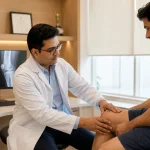
Physical examination. An orthopedic doctor asks about your history and previous injuries, then checks the location of pain, swelling, tenderness, range of motion, muscle strength, joint stability, alignment, and walking pattern.
Imaging tests. These are chosen based on your findings, and most patients do not need all of them:
- X-ray: Shows bones, alignment, joint-space changes, arthritis, and certain injuries.
- MRI: Shows soft tissues such as the meniscus, ligaments, cartilage, and tendons. It is not needed for every patient.
- CT scan: Useful in selected cases, such as detailed assessment of certain bone injuries or complex anatomy.
Knee Pain Treatment Options
Can knee pain improve without surgery? Yes, many knee conditions can initially be managed without surgery, though this does not apply to every condition. Options may include:
- Activity modification and rest when appropriate
- Physiotherapy and strengthening exercises
- Weight management where medically appropriate
- Bracing in selected cases
- Ice or heat where appropriate
- Pain-management strategies recommended by a healthcare professional
- Treatment of the underlying condition
Physiotherapy can help selected patients build strength, flexibility, range of motion, and balance. It also supports movement retraining, recovery after injury or surgery, and a gradual return to activity. Exercises must suit your condition.
Injections may be considered for selected patients. The decision depends on diagnosis, severity, previous treatment, medical history, and your goals. They are not suitable for everyone.
When Is Surgery or Knee Replacement Considered?
Surgery is not automatically required. It may be considered for:
- Significant structural damage
- Certain ligament injuries
- Meniscus injuries in selected patients
- Advanced osteoarthritis with persistent symptoms
- Persistent symptoms despite appropriate non-surgical treatment
- Major injury affecting knee stability or function
- Certain fractures or complex injuries
The decision rests on examination, imaging, symptoms, functional limits, age, activity needs, and overall health.
Knee replacement replaces damaged joint surfaces with artificial implants. It may be considered when arthritis is advanced, pain significantly affects daily activities, walking is difficult, and non-surgical treatment has not given adequate relief. It is not decided by X-ray alone. It should be a shared decision between you and your orthopedic surgeon.
What Is Robotic Knee Replacement?
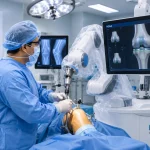
Robotic-assisted knee replacement uses computer-assisted planning and measurements to guide the surgeon. It involves pre-operative planning, surgical guidance, and help with implant positioning. Surgeon experience and appropriate patient selection remain essential. Robotic surgery is not automatically superior for every patient, so ask your surgeon whether it suits your case.
Home Care, Pain Management and Recovery
For mild knee pain:
- Avoid activities that clearly worsen pain
- Rest appropriately and keep up gentle movement if advised
- Use cold or heat only when appropriate
- Follow any prescribed treatment
- Avoid returning suddenly to intense exercise
- Seek assessment if symptoms persist or worsen
Pain relief. Doctors may recommend pain-relief medicines depending on your age, medical history, kidney and liver health, other medications, and the cause and severity of pain. Do not self-medicate on the basis of general advice.
How long does it take to improve? There is no single timeline. Recovery depends on the condition, severity, age, treatment, previous injury, general health, rehabilitation, and activity level. Feeling better and full tissue recovery are not always the same thing.
Persistent problems. Ongoing knee problems may lead to reduced mobility, muscle weakness, stiffness, recurrent swelling, instability, or difficulty with daily tasks. In some conditions, joint damage can progress. This is why persistent symptoms deserve proper evaluation.
Orthopedic Surgeon in Kanakapura Road: What Local Patients Should Know
People searching for an orthopedic surgeon in Kanakapura Road often need help with persistent knee pain, sports injuries, arthritis, ligament problems, or meniscus injuries. Whether you live in JP Nagar, Banashankari, or Jayanagar, or elsewhere in South Bangalore, easy access to a specialist makes follow-up care simpler.
If you are looking for an orthopedic doctor in Kanakapura Road, look for a qualified professional who will examine you, recommend imaging only when needed, and explain your treatment options clearly. An orthopedic clinic in Kanakapura Road should be able to guide knee pain treatment in Kanakapura Road, from non-surgical care to surgery, including a knee replacement surgeon in Kanakapura Road for advanced cases. The same applies to any knee specialist in Bangalore or knee pain doctor in Bangalore, and to joint pain treatment in Bangalore more broadly.
Why Choose an Orthopedic Specialist for Knee Care?
A specialist can:
- Diagnose accurately and identify the source of pain
- Assess joint stability and previous injuries
- Choose appropriate imaging
- Consider non-surgical treatment first when suitable
- Identify patients who may benefit from surgery
- Plan rehabilitation and long-term follow-up
Dr. Vijay Kulkarni is an orthopedic surgeon whose clinical expertise includes knee care, sports injuries, arthroscopy, joint replacement, trauma, and fracture care.
When Should You See an Orthopedic Surgeon?
Book an assessment if:
- Knee pain persists or keeps returning
- Swelling is significant
- You cannot comfortably bear weight
- Movement is severely restricted, or the knee feels unstable
- There is locking or catching
- Pain follows a sports injury, fall, or accident
- Symptoms interfere with daily life
- Previous treatment has not helped enough
- Imaging shows a structural problem
Prevention and Knee Health Tips
- Maintain a healthy body weight where appropriate
- Strengthen the muscles around the knee and stay active
- Warm up before sports and increase intensity gradually
- Wear suitable footwear and use proper technique
- Avoid sudden jumps in training load
- Address old injuries properly
- Work on balance and flexibility
- Seek assessment for persistent symptoms
Comparison Tables
Non-Surgical vs Surgical Treatment
| Factor | Non-Surgical Treatment | Surgical Treatment |
| Typical use | Many mild to moderate conditions and selected injuries | Selected structural problems or advanced joint disease |
| Main methods | Physiotherapy, activity modification, medication as advised, braces | Arthroscopy, ligament procedures, fracture fixation, knee replacement where appropriate |
| Hospital procedure | Usually not required | Usually involves a procedure |
| Rehabilitation | May be required | Usually required |
| Decision | Based on diagnosis and symptoms | Based on diagnosis, severity, function and treatment response |
Mild Knee Pain vs Symptoms Requiring Medical Evaluation
| Feature | Mild/Temporary Symptoms | Symptoms Requiring Evaluation |
| Pain | May improve with rest | Persistent or worsening |
| Swelling | Mild or temporary | Significant or recurrent |
| Movement | Usually possible | Severely restricted |
| Weight-bearing | Usually possible | Difficult or impossible |
| Injury | Minor or unclear | Significant trauma |
| Deformity | Usually absent | May be present |
Common Knee Conditions
| Condition | Common Features | Typical Evaluation |
| Osteoarthritis | Pain, stiffness, activity-related symptoms | Clinical examination, X-ray when appropriate |
| Meniscus injury | Pain, swelling, catching or locking | Clinical examination, MRI in selected cases |
| Ligament injury | Instability, swelling after injury | Clinical examination, imaging when appropriate |
| Tendon problems | Localized pain, activity-related symptoms | Examination, imaging in selected cases |
| Sports injury | Pain, swelling, reduced function | Clinical examination and appropriate imaging |
Knee Treatment Options
| Treatment | When It May Be Used |
| Activity modification | Many overuse and painful conditions |
| Physiotherapy | Strength, flexibility and movement problems |
| Brace | Selected injuries or instability |
| Medication | Symptom management when medically appropriate |
| Injection | Selected conditions after medical evaluation |
| Arthroscopy | Selected structural knee problems |
| Knee replacement | Advanced joint disease in appropriate patients |
Frequently Asked Questions:
1. What are the most common causes of knee pain?
Common causes include osteoarthritis, ligament or meniscus injuries, overuse, muscle weakness, tendon irritation, cartilage damage, and old injuries. Some inflammatory conditions can also affect the knee. Because symptoms overlap, an orthopedic examination, with imaging where needed, is the reliable way to find the cause.
2. Can knee pain improve without surgery?
Often, yes. Many knee conditions are first managed with activity modification, physiotherapy, strengthening exercises, bracing in selected cases, and medication advised by a doctor. Whether this works depends on the cause and severity. Persistent or worsening pain should be assessed by an orthopedic specialist.
3. When should I see an orthopedic surgeon for knee pain?
See one if pain persists or keeps returning, swelling is significant, the knee feels unstable, locks or catches, or symptoms follow a fall or sports injury. Also go if daily activities are affected. Inability to bear weight after injury, deformity, or fever with a hot, swollen knee needs urgent care.
4. What is the best treatment for knee pain?
There is no single best treatment. The right approach depends on the diagnosis, severity, age, activity level, overall health, and your goals. Many people start with non-surgical care, while surgery may suit specific structural problems. An orthopedic examination helps guide the plan.
5. How long does knee pain take to improve?
It varies. Recovery depends on the condition, severity, age, treatment, general health, rehabilitation, and activity level. Symptom relief and full tissue healing are not always the same. Your doctor can give a more realistic outlook after examining you, but no exact timeline can be promised.
6. When is knee replacement considered?
It may be considered when knee arthritis is advanced, pain limits daily activities or walking, and non-surgical treatment has not given enough relief. The decision is not based on an X-ray alone. It combines symptoms, examination, imaging, and health, and is made jointly by you and your surgeon.
7. Can sports injuries cause long-term knee pain?
They can in some cases, especially if ligament, meniscus, or cartilage injuries are not properly assessed or rehabilitated. Many people recover well with appropriate care. If pain, swelling, or instability continues after a sports injury, get an orthopedic evaluation.
8. Where can I consult an orthopedic surgeon near Kanakapura Road?
Patients around Kanakapura Road, JP Nagar, Jayanagar, Banashankari, and nearby South Bangalore areas can book a consultation with Dr. Vijay Kulkarni through the website. The visit typically includes an examination, imaging where needed, and a discussion of suitable treatment options.
Conclusion
Knee pain can come from many causes, including osteoarthritis, injuries, overuse, and structural problems. Not every knee problem needs surgery, and non-surgical treatment, including physiotherapy, may suit many patients. Surgery may be considered for specific structural problems, and knee replacement for selected patients with significant joint damage and persistent symptoms. A clinical examination and appropriate imaging guide these decisions. If your symptoms persist, consulting an orthopedic surgeon in Kanakapura Road can help you find the cause and understand your options.