If your knee pain has gone from an occasional ache to something that stops you from walking to the market or climbing stairs comfortably, you’ve probably searched online and come across two terms that sound almost identical: knee replacement and total knee replacement. Are they the same thing, or is one more advanced than the other? As a Total Knee Replacement Surgeon in Vajarahalli, Dr. Vijay Kulkarni regularly meets patients confused by this exact question. Understanding the difference can help you make an informed decision about your treatment, rather than feeling overwhelmed by medical jargon at a time when you simply want relief from pain.
Knee replacement is an umbrella term covering surgeries that resurface a damaged knee, including partial and total procedures. Total knee replacement (TKR) replaces the entire joint surface — the femur, tibia, and often the kneecap — and is used when arthritis or damage affects the whole knee. Partial knee replacement addresses only one damaged compartment and preserves healthy bone and ligaments. The right choice depends on the extent of joint damage, age, activity level, and overall health. An orthopedic specialist evaluates X-rays, symptoms, and mobility to recommend the most suitable procedure, ensuring long-term pain relief and improved function.
Understanding Knee Replacement Surgery
Knee replacement surgery, also called knee arthroplasty, is a procedure where damaged cartilage and bone in the knee joint are removed and replaced with an artificial implant. It’s performed when the knee joint has worn down enough that pain, stiffness, and reduced mobility interfere with daily life, and conservative treatments no longer help.
There are two broad types of knee replacement:
- Partial Knee Replacement (PKR): Only the damaged compartment is resurfaced.
- Total Knee Replacement (TKR): All three compartments of the knee are replaced.
The choice between them depends on how much of the joint is affected.
What is Total Knee Replacement (TKR)?
Total knee replacement involves resurfacing the entire knee joint — the end of the thighbone (femur), the top of the shinbone (tibia), and sometimes the underside of the kneecap (patella) — with metal and plastic components.
What’s typically replaced:
- Femoral component
- Tibial component
- Plastic spacer (to mimic cartilage)
- Patellar button (in some cases)
Suitable candidates:
- Patients with arthritis affecting multiple compartments of the knee
- Those with significant deformity (bow-leg or knock-knee patterns)
- Patients who haven’t responded to non-surgical treatment
Benefits: Long-lasting pain relief, restored alignment, and significant improvement in walking and daily function.
Recovery expectations: Most patients begin walking with support within 24–48 hours and return to most normal activities within 6–12 weeks, with full recovery over a few months.
What is Partial Knee Replacement (PKR)?
Partial knee replacement resurfaces only the damaged compartment of the knee — commonly the inner (medial) side — while leaving healthy bone, cartilage, and ligaments untouched.
Advantages:
- Smaller incision and less tissue disruption
- Often faster recovery
- Preserves more natural knee movement
Limitations:
- Only suitable for patients with damage confined to one compartment
- Not appropriate for widespread arthritis
- May require conversion to total knee replacement later if arthritis progresses elsewhere in the joint
Knee Replacement vs Total Knee Replacement
The term “knee replacement” includes both partial and total procedures, so the real comparison patients need is partial versus total. Here’s how they differ across key factors:
| Factor | Partial Knee Replacement | Total Knee Replacement |
| Surgical approach | Smaller incision, minimally invasive | Larger incision, full joint access |
| Amount of joint replaced | One compartment only | Entire joint surface |
| Recovery | Often quicker | Slightly longer, but very predictable |
| Cost | Generally lower | Higher, due to more extensive surgery |
| Longevity | Good, but may need revision later | 15–20+ years in most patients |
| Risks | Lower tissue disruption | Standard surgical risks apply |
| Best suited for | Limited, single-compartment arthritis | Widespread, advanced arthritis |
Causes That May Lead to Knee Replacement
- Osteoarthritis (most common cause)
- Rheumatoid arthritis
- Post-traumatic arthritis following injury
- Severe cartilage damage
- Knee deformities (bow-leg, knock-knee)
- Sports injuries left untreated
- Failed previous knee treatments or surgeries
Signs You May Need Knee Replacement Surgery
Consider an orthopedic evaluation if you experience:
- Persistent knee pain that limits daily activity
- Difficulty walking even short distances
- Pain while climbing or descending stairs
- Ongoing stiffness that limits bending or straightening the knee
- Visible swelling that doesn’t settle
- Reduced mobility affecting independence
- Pain that disturbs sleep at night
- No lasting relief from medications, injections, or physiotherapy
Diagnosis by an Orthopedic Surgeon
An accurate diagnosis combines several steps:
- Physical examination: Checking range of motion, alignment, and stability
- Medical history: Understanding pain patterns, past injuries, and prior treatments
- X-rays: To assess joint space narrowing and bone damage
- MRI: For detailed soft tissue and cartilage evaluation
- CT scan: Used selectively for complex bone deformities
- Functional assessment: Evaluating walking pattern and daily activity limitations
Non-Surgical Treatments Before Surgery
Surgery is usually considered only after conservative options no longer provide adequate relief. These include:
- Physiotherapy and targeted strengthening exercises
- Weight management to reduce joint load
- Activity modification
- Pain medications (under medical guidance)
- Knee braces or supports
- Corticosteroid injections
- Hyaluronic acid (viscosupplementation) injections
- PRP (Platelet-Rich Plasma) therapy
When is Total Knee Replacement Necessary?
Total knee replacement becomes the recommended option when:
- Arthritis has advanced across multiple parts of the knee
- Joint damage significantly affects quality of life
- Pain persists despite months of conservative treatment
- Functional limitations prevent basic daily activities like standing, walking, or climbing stairs
Benefits of Total Knee Replacement
- Substantial, long-lasting pain relief
- Improved mobility and walking ability
- Better overall quality of life
- Greater independence in daily activities
- Long-term durability with modern implants
- High success and patient satisfaction rates
Recovery Timeline After Total Knee Replacement
- Hospital stay: Typically 2–4 days
- Walking: Most patients stand and walk with support within 24–48 hours
- Physiotherapy milestones: Structured rehabilitation begins almost immediately and continues for several weeks
- Return to work: Desk-based work in 4–6 weeks; physically demanding jobs may take longer
- Driving: Usually resumes around 4–6 weeks, once comfortable control of the leg returns
- Daily activities: Most routine tasks resume within 6–8 weeks
- Full recovery: Complete strength and adaptation may take 3–6 months
Risks and Complications
While total knee replacement has a strong safety record, as with any surgery, potential risks include infection, blood clots, implant wear over time, temporary stiffness, nerve-related discomfort, and, rarely, the need for revision surgery. Choosing an experienced surgical team and following post-operative guidance significantly reduces these risks.
Prevention Tips for Knee Joint Damage
- Maintain a healthy body weight to reduce joint stress
- Stay active with low-impact exercises like walking or swimming
- Strengthen muscles around the knee, especially the quadriceps
- Use proper technique and protection during sports to prevent injury
- Maintain good posture and joint alignment
- Seek early treatment for knee pain instead of waiting
When Should You Consult an Orthopedic Surgeon?
If knee pain persists beyond a few weeks, worsens with activity, disturbs sleep, or limits your ability to walk or climb stairs, it’s time to consult a specialist. Early evaluation often opens up more treatment options, including non-surgical ones, and helps prevent further joint deterioration.
Comparison Tables
Partial Knee Replacement vs Total Knee Replacement
| Feature | Partial Knee Replacement | Total Knee Replacement |
| Joint coverage | One compartment | Entire joint |
| Ideal candidate | Localized arthritis | Widespread arthritis |
| Incision size | Smaller | Larger |
| Recovery speed | Generally faster | Standard, predictable |
| Revision likelihood | Slightly higher over time | Lower |
Non-Surgical Treatment vs Knee Replacement
| Aspect | Non-Surgical Treatment | Knee Replacement |
| Best for | Early to moderate arthritis | Advanced arthritis |
| Pain relief | Temporary, variable | Long-term |
| Invasiveness | None | Surgical |
| Recovery time | Not applicable | Weeks to months |
Temporary Knee Pain vs Advanced Arthritis
| Indicator | Temporary Knee Pain | Advanced Arthritis |
| Duration | Days to a few weeks | Persistent, months to years |
| Response to rest/medication | Improves | Little to no improvement |
| Impact on mobility | Minimal | Significant |
| Imaging findings | Usually normal | Joint space narrowing, bone changes |
Robotic Knee Replacement vs Conventional Knee Replacement
| Factor | Robotic Knee Replacement | Conventional Knee Replacement |
| Precision | Enhanced, computer-guided alignment | Surgeon-guided, manual technique |
| Personalization | Highly customized to patient anatomy | Standardized approach |
| Recovery | Often smoother | Also effective, well-established |
| Availability | Growing in advanced centers | Widely available |
Frequently Asked Questions
1. What is the difference between knee replacement and total knee replacement?
Knee replacement is a general term covering both partial and total procedures. Total knee replacement replaces the entire knee joint surface, while partial knee replacement treats only the damaged compartment, depending on the extent of arthritis.
2. Who is a good candidate for total knee replacement?
Patients with advanced arthritis affecting multiple parts of the knee, significant deformity, or persistent pain that does not improve with medication, physiotherapy, or other conservative treatments are usually good candidates after a detailed orthopedic evaluation.
3. How long does total knee replacement last?
Modern knee implants generally last 15–20 years or longer, depending on implant quality, activity level, body weight, and adherence to post-operative care recommendations.
4. Is robotic knee replacement better?
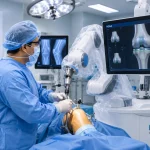
Robotic-assisted knee replacement provides enhanced surgical precision and personalized implant alignment, which may improve implant positioning and recovery. However, conventional knee replacement also offers excellent long-term outcomes when performed by an experienced orthopedic surgeon.
5. Can I climb stairs after surgery?
Yes. Most patients can climb stairs with support within a few weeks after surgery and gradually regain the strength and flexibility needed to climb comfortably without assistance during rehabilitation.
6. How painful is recovery?
Some pain and discomfort are normal immediately after surgery but are effectively managed with medications and physiotherapy. Pain gradually decreases over the following weeks as healing progresses.
7. How soon can I walk?
Most patients begin walking with support within 24–48 hours after surgery. Walking ability steadily improves over the following weeks with regular physiotherapy and rehabilitation.
8. What is the success rate?
Total knee replacement has a very high success rate, with most patients experiencing significant pain relief, improved joint function, and better mobility for many years after surgery.
9. What age is best for knee replacement?
There is no fixed age for knee replacement. The decision depends mainly on the severity of arthritis, pain levels, mobility limitations, and the patient’s overall health rather than age alone.
10. Is physiotherapy necessary after surgery?
Yes. Physiotherapy is a vital part of recovery, helping restore knee strength, flexibility, balance, and mobility while maximizing the long-term success of the surgery.
11. Can arthritis be treated without surgery?
Yes. Early and moderate arthritis can often be managed with physiotherapy, weight management, medications, activity modification, and joint injections. Surgery is generally recommended only when these treatments no longer provide adequate relief.
12. How long is hospitalization for knee replacement?
Most patients remain in the hospital for 2 to 4 days, depending on their recovery, pain control, mobility, and overall medical condition.
13. What activities should I avoid after surgery?
High-impact activities such as running, jumping, and contact sports should generally be avoided. Low-impact exercises like walking, cycling, swimming, and prescribed physiotherapy are encouraged after your surgeon’s approval.
14. How do I choose the best knee replacement surgeon?
Choose a board-certified orthopedic surgeon with extensive experience in knee replacement, proven patient outcomes, transparent communication, and access to advanced techniques such as robotic-assisted knee replacement.
15. When should I consult an orthopedic specialist?
If knee pain lasts for several weeks, limits daily activities, affects sleep, or does not improve with rest, medications, or home care, consult an orthopedic specialist for a detailed evaluation and personalized treatment plan.
Conclusion
Understanding the difference between knee replacement and total knee replacement empowers you to have a more informed conversation with your surgeon. While “knee replacement” broadly covers both partial and total procedures, the right choice depends on how much of your knee joint is affected and how it’s impacting your daily life. If persistent pain, stiffness, or reduced mobility are holding you back, consulting an experienced Total Knee Replacement Surgeon in Vajarahalli can help you understand your options clearly and move toward lasting relief, rather than living with ongoing discomfort.
Book Appointment:
Living with knee pain in Vajarahalli, JP Nagar, Jayanagar, Banashankari, Bannerghatta Road, or Doddakallasandra? Don’t let arthritis limit your independence any longer. Schedule a consultation with Dr. Vijay Kulkarni, an experienced orthopedic surgeon specializing in knee replacement and robotic joint replacement, for a personalized diagnosis and treatment plan tailored to your needs. Book your appointment today and take the first step toward pain-free movement.