Introduction
Hip pain that lasts for weeks can change how you walk, sleep, and work. If you are researching robotic hip replacement in Electronic City, you may be wondering what the technology does and whether it suits you.
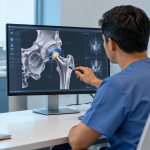
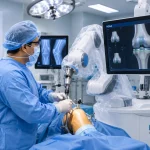
In robotic-assisted hip replacement, planning software and a robotic guidance system support the surgeon during selected parts of the operation. The surgeon still makes the clinical decisions and performs the surgery. Robotic platforms differ from one another, and not every patient needs robotic assistance. Whether hip replacement is suitable at all depends on your diagnosis, imaging, anatomy, general health, goals, and response to non-surgical care. This guide explains the basics in plain language.
Robotic hip replacement is a form of total hip arthroplasty in which computer-assisted planning and a robotic guidance system support the surgeon during selected steps, such as positioning the socket and stem components. The surgeon remains in charge of every decision. Potential benefits relate to planning and positioning. Better long-term outcomes are not guaranteed, and conventional surgery remains an established option. Cost in Bangalore varies with the hospital, implant, technology charges, and length of stay, so a written itemised estimate helps. Recovery depends on health, surgical factors, and rehabilitation, and follows a staged path of walking, physiotherapy, and follow-up. An orthopedic assessment decides whether surgery is needed at all.
What Is Robotic Hip Replacement?
The hip is a ball-and-socket joint. The rounded upper end of the thigh bone (the ball) fits into a cup-shaped part of the pelvis (the socket). Smooth cartilage covers both surfaces so they glide easily.
Hip osteoarthritis slowly wears this cartilage away. Other causes of hip joint degeneration include inflammatory arthritis, loss of blood supply to the bone, past injury, and developmental hip problems. The WHO describes osteoarthritis as a chronic, often progressive condition that is common in the hips and knees.
In total hip replacement (total hip arthroplasty), the surgeon removes the damaged joint surfaces and fits artificial parts, called implants, for the ball and the socket.
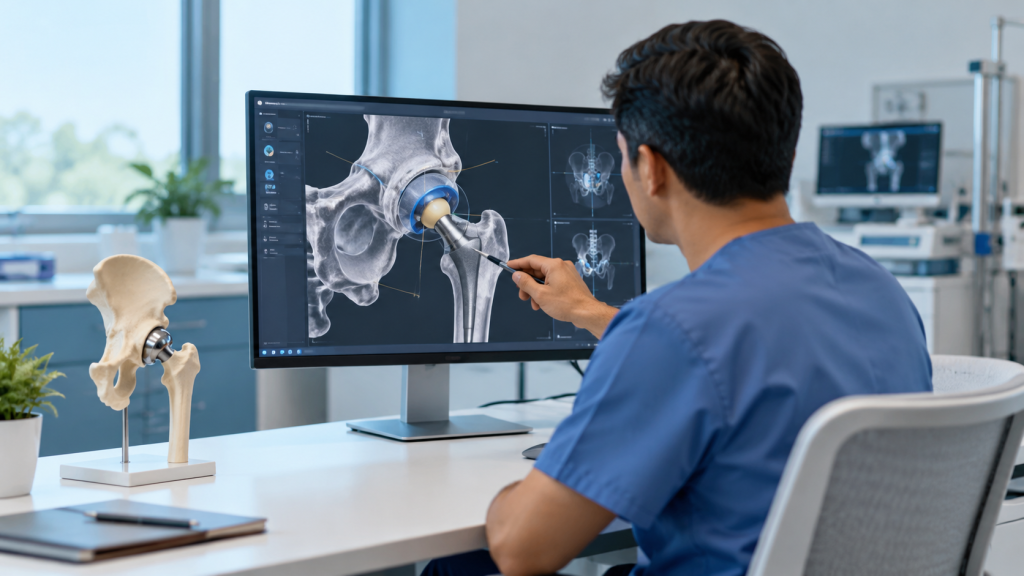
Robotic-assisted hip replacement adds technology to this operation. Depending on the system, it may include:
- Computer-assisted surgical planning, sometimes using three-dimensional images
- Patient-specific planning for the socket (acetabular) and stem (femoral) component positions
- Robotic guidance or feedback during selected steps, such as preparing the socket
This is not an autonomous operation. The surgeon is responsible for choosing the patient, making the plan, using clinical judgement, and performing the procedure. Systems also differ. Some use a preoperative CT scan, while others use different imaging, registration, or planning methods. What one hospital offers may not match another. Systems for other joints also differ, as with robotic knee replacement.
Who May Need Hip Replacement Surgery?
Hip pain alone does not mean you need an operation. Hip replacement surgery is usually considered when symptoms and daily limits stay significant despite appropriate non-surgical care, or when clinical findings support surgery. Possible reasons include:
- Advanced hip osteoarthritis
- Persistent pain that affects daily activities
- Stiffness and reduced hip movement
- Difficulty walking, sitting, or climbing stairs
- Structural damage to the hip joint
- Too little improvement with non-surgical treatment
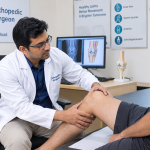
Assessment usually covers your medical history, a physical examination, imaging, how severe your symptoms are, treatments you have already tried, your general health, and your goals.
Other problems can also cause hip pain, including back problems, muscle or tendon problems, and injuries. Some need different treatment. Sports-related causes, for example, are covered under sports injury treatment, and injury-related joint damage may need trauma and fracture care.
Who May Be Suitable for Robotic Hip Replacement?
Not every patient who needs a hip replacement needs a robotic system. Suitability depends on:
- The diagnosis and how severe the joint damage is
- Hip anatomy and bone condition
- The type of hip replacement being considered
- Overall medical fitness
- Functional goals and activity needs
- The robotic system and surgical techniques available
- The surgeon’s assessment and treatment plan
Only a clinical evaluation, with imaging, can show whether robotic assistance is an option for you.
How Does Robotic-Assisted Total Hip Arthroplasty Work?
The exact steps differ by robotic system, surgical approach, and patient anatomy. In general:
- Preoperative assessment: The team reviews symptoms, medical history, examination findings, and imaging.
- Surgical planning: The surgeon builds a plan from your anatomy and the available technology.
- System preparation: The team sets up and calibrates the robotic system as that platform requires.
- Intraoperative guidance: The system gives planning support, measurements, boundaries, or feedback during selected steps.
- Joint preparation: The surgeon removes damaged joint surfaces and prepares the bone.
- Implant placement: The surgeon positions the chosen components using the plan and the available guidance.
- Final assessment: The team checks the reconstruction, joint function, and stability.
- Postoperative care: You receive monitoring, pain management, mobility guidance, and rehabilitation.
Potential Benefits of Robotic-Assisted Hip Replacement
Possible technical benefits include:
- Patient-specific preoperative planning
- Extra information about your anatomy
- Guidance during selected surgical steps
- Support for socket and stem positioning
- Checks of selected alignment or joint measurements, depending on the system
- Help in carrying out the planned procedure
These are technical features. They are not the same as proven patient outcomes. Several published reviews report more precise component placement with robotic assistance, but reviews generally do not find a clear difference in patient-reported function. Robotic assistance does not guarantee less pain, faster recovery, fewer complications, better function, longer-lasting implants, or fewer revision procedures. Results depend on the diagnosis, surgical technique, implant choice, your health, and rehabilitation.
Robotic vs Conventional Hip Replacement
| Factor | Robotic-Assisted Hip Replacement | Conventional Hip Replacement |
| Surgical planning | May use computer-assisted, patient-specific planning | Uses established preoperative planning methods |
| Intraoperative guidance | Robotic technology assists selected steps | Surgeon uses conventional instruments and established techniques |
| Surgeon involvement | Surgeon makes decisions and performs the operation | Surgeon makes decisions and performs the operation |
| Technology | Requires a compatible robotic platform | Does not require a robotic platform |
| Imaging requirements | Depend on the particular system | Depend on the surgical plan and clinical requirements |
| Component positioning | Technology may provide additional planning or positioning guidance | Surgeon uses conventional planning and surgical techniques |
| Availability | Depends on facility and system access | Available at facilities offering conventional hip replacement |
| Cost | May be higher depending on the facility and technology | Depends on the facility, surgeon, implant, and treatment plan |
| Recovery | Depends on multiple patient and treatment factors | Depends on multiple patient and treatment factors |
Neither method is universally superior. Conventional hip replacement remains an established treatment.
Is Robotic Hip Replacement Better Than Conventional Surgery?
It depends on the patient, the system, and the surgical approach. Robotic assistance may add planning and guidance, but whether that gives you a meaningful advantage is not certain. Evidence is still developing.
Useful points to compare with your surgeon:
- The clinical reason for surgery
- The approach your surgeon recommends and why
- Implant selection
- Expected benefits and limits
- Risks and possible complications
- Total cost
- Rehabilitation needs
- Follow-up arrangements
Robotic Hip Replacement Cost in Bangalore
No single price applies to every hospital or patient, so this article does not quote one. When you search for robotic hip replacement Bangalore options, ask for a written, itemised estimate. Costs depend on:
- Type of hip replacement
- Robotic platform and technology charges
- Implant type and brand
- Room category and length of stay
- Surgeon and anaesthesia fees
- Preoperative tests
- Extra medical care for other conditions
- Medicines after surgery
- Physiotherapy and follow-up visits
- Insurance cover, exclusions, and approvals
Questions to ask:
- What does the package include?
- Are robotic technology charges separate?
- Which implant components are included?
- Are preoperative tests included?
- What are the charges for extra hospital days?
- Are medicines, physiotherapy, and follow-up visits included?
- What does my insurance exclude?
What Happens During Hip Replacement Treatment in Bangalore?
A typical pathway includes:
- An initial orthopedic consultation
- Medical history and physical examination
- Imaging and needed tests
- Review of non-surgical options
- Surgical planning, if replacement is advised
- A pre-anaesthesia check
- Hospital admission and the operation
- Monitoring after surgery
- Getting up and moving, with physiotherapy
- Follow-up consultations
The exact pathway and package inclusions vary by facility and by your medical needs.
Risks and Limitations of Robotic Hip Replacement
Hip replacement is a well-established operation, but every surgery carries risks. They include:
- Infection
- Blood clots
- Bleeding
- Dislocation
- Difference in leg length
- Ongoing pain
- Fracture around the implant
- Nerve or blood vessel injury
- Implant loosening or wear
- Anaesthesia-related complications
- The need for further surgery in some cases
Robotic assistance does not remove these risks. Robotic systems add their own considerations, such as registration errors, equipment problems, or technical interruptions. If the technology cannot be used as planned, the surgeon may switch to an alternative method. Complications are not inevitable, and your surgeon can explain how these risks apply to you.
How to Prepare for Robotic Hip Replacement
- Attend the recommended medical assessment.
- Share your medical conditions, allergies, and medicines.
- Discuss blood thinners and other medicines with your treating team. Do not change prescribed medicine without medical advice.
- Complete the tests and imaging you are given.
- Follow the instructions about food, drink, and medicines before surgery.
- Arrange transport and help at home.
- Make your home safe, for example by clearing walkways.
- Ask about walking aids and rehabilitation.
- Discuss quitting smoking, if it applies to you.
- Discuss diabetes and other health conditions with your team.
Robotic Hip Surgery Recovery
Recovery generally includes:
- Monitoring right after surgery
- Pain and swelling management
- Early movement when medically appropriate
- Assisted walking and mobility training
- Prescribed physiotherapy and exercises
- A gradual return to daily activities
- Follow-up assessment
Factors that affect recovery include your age and general health, muscle strength before surgery, the type of procedure and approach, pain control, surgical and medical factors, how well you take part in rehabilitation, and the support you have at home. Robotic assistance should not be assumed to make recovery faster.
How Long Does Recovery Take After Hip Replacement?
Recovery varies a lot from person to person, and no timeline is guaranteed.
- Early movement may begin soon after surgery when it is safe.
- Walking aids may be needed at first.
- Stairs depend on your strength, balance, and your team’s advice.
- Driving should restart only when your treating team confirms it is safe and legal for you.
- Work depends on your job duties and progress.
- Strength, flexibility, and stamina may keep improving over several months.
- Follow-up visits help check progress and answer concerns.
Physiotherapy After Hip Replacement
Rehabilitation helps you:
- Improve movement
- Strengthen the muscles around the hip
- Improve balance
- Build confidence when walking
- Follow any movement precautions
- Return gradually to daily activities
- Reduce avoidable stiffness
Follow the programme your own team prescribes. Exercises meant for another patient may not suit you.
Robotic Hip Replacement in Electronic City and Bangalore
People in Electronic City and across Bangalore often compare techniques, technology, implants, costs, rehabilitation, and consultation options before choosing. Searching for robotic hip replacement in Electronic City is a sensible first step, but the search location is not the same as where a consultation or operation actually happens, so check this directly.
Reading about robotic vs conventional hip replacement and robotic assisted total hip arthroplasty can help you prepare questions. The same goes for robotic hip surgery recovery. To compare options:
- Verify the surgeon’s qualifications and relevant clinical practice.
- Confirm that robotic hip replacement is offered at the proposed facility.
- Ask which robotic system is used and what it does during the operation.
- Understand why partial or total hip replacement is being considered, where relevant.
- Request an itemised cost estimate.
- Ask about alternatives, risks, limits, and rehabilitation.
- Confirm the hospital where treatment will take place.
- Clarify follow-up arrangements and whom to contact with concerns after surgery.
Patients from areas such as JP Nagar, Jayanagar, Banashankari, Bannerghatta Road, and Kanakapura Road may also compare travel time for repeat visits during rehabilitation.
Why Consult an Orthopedic Surgeon About Hip Replacement?
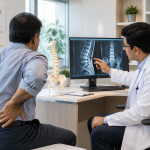
An orthopedic consultation helps you:
- Find the cause of your hip pain
- Assess joint damage
- Review appropriate imaging
- Consider non-surgical treatment
- Decide whether replacement is appropriate
- Compare surgical techniques
- Discuss implant choices
- Review potential benefits, limits, and risks
- Plan rehabilitation and follow-up
Dr. Vijay A. Kulkarni is an orthopedic surgeon whose website lists hip replacement surgery and robotic hip replacement among his clinical services. It shows consultation locations at Encore Speciality Clinics on Kanakapura Road and at KIMS Hospitals in Electronic City. Please confirm current availability, the consultation location, and the surgical facility with the practice before booking.
When Should You Seek Medical Assessment for Hip Pain?
Arrange an orthopedic consultation if you have:
- Persistent hip pain
- Increasing stiffness
- Difficulty walking
- Pain that affects sleep or daily activity
- Reduced hip movement
- Symptoms that do not improve with recommended treatment
- Imaging findings that suggest significant joint damage
Get prompt medical help for sudden severe hip pain, being unable to put weight on the leg (especially after a fall or injury), or hip pain with fever or feeling seriously unwell, because infection or a fracture may be possible. This guide cannot diagnose you.
Tips for Maintaining Hip Health
- Stay regularly active in ways that suit you.
- Strengthen your muscles as advised.
- Maintain a healthy body weight where appropriate.
- Avoid sudden jumps in exercise intensity.
- Wear suitable footwear.
- Seek assessment for persistent hip pain.
- Follow prescribed treatment for arthritis and other conditions. Non-surgical hip arthritis treatment can include exercise therapy, activity changes, and medicines, and a knee pain guide shows how similar conservative care works for another joint.
- Ask a healthcare professional about suitable exercise and nutrition.
These steps cannot always prevent osteoarthritis or remove the need for surgery.
16. Comparison Tables
(The robotic vs conventional table appears in the article above.)
Table A: Non-Surgical Care vs Hip Replacement Surgery
| Factor | Non-Surgical Care | Hip Replacement Surgery |
| Typical use | Symptoms that may be managed without surgery | Significant joint damage and symptoms when surgery is appropriate |
| Methods | Exercise therapy, activity modification, medicines, and other clinician-recommended options | Replacement of damaged joint surfaces with implants |
| Recovery | Depends on the treatment and underlying condition | Requires postoperative recovery and rehabilitation |
| Decision | Based on symptoms, examination, and clinical needs | Based on symptoms, imaging, health, alternatives, and patient goals |
Table B: Factors That Affect Robotic Hip Replacement Cost
| Cost factor | Why it matters |
| Type of procedure | The surgical plan affects the total cost |
| Robotic technology | Platform and technology charges may vary |
| Implant selection | Implant components and specifications affect pricing |
| Hospital stay | Room category and length of stay affect the total |
| Investigations | Preoperative testing adds to the overall cost |
| Additional medical care | Other health conditions may require extra treatment |
| Rehabilitation | Physiotherapy and follow-up may be charged separately |
| Insurance | Coverage depends on the policy and approvals |
Table C: General Hip Replacement Recovery Stages
| Recovery stage | General focus |
| Early postoperative period | Monitoring, pain management, and safe mobilisation |
| Initial rehabilitation | Walking support and prescribed movement exercises |
| Progressive recovery | Improving strength, movement, and daily function |
| Longer-term recovery | Continued functional improvement and follow-up |
These are general stages, not guaranteed timelines. Individual recovery and movement precautions vary.
Frequently Asked Questions
What is robotic hip replacement?
Robotic hip replacement is hip replacement surgery in which planning software and a robotic guidance system support the surgeon during selected steps. The surgeon makes the clinical decisions and performs the operation; the robot does not work independently. Systems differ in their imaging, planning, and guidance features. Suitability depends on diagnosis, anatomy, imaging, general health, and goals, so an orthopedic assessment is needed to decide.
What is the robotic hip replacement cost in Bangalore?
There is no single robotic hip replacement cost in Bangalore, because the total depends on the hospital, room category, implant, technology charges, and the patient’s health needs. This article does not quote a price. Ask for a written, itemised estimate that lists what is included, such as tests, implants, hospital stay, medicines, physiotherapy, and follow-up visits. Check your insurance policy for exclusions and approval requirements.
What are the benefits of robotic-assisted hip replacement?
The possible benefits are mostly technical: patient-specific planning, extra anatomical information, and guidance when positioning the socket and stem components. These features may help the surgeon carry out a plan. However, technical benefits do not guarantee less pain, faster recovery, fewer complications, or longer-lasting implants. Research comparing robotic-assisted and conventional surgery continues, and results vary by system and patient. Discuss expected benefits with your surgeon.
Is robotic hip replacement better than conventional surgery?
Whether robotic hip replacement is better depends on the patient, the system, and the surgical approach. Some studies report more precise component positioning, while reviews generally find no clear difference in patient-reported function. Conventional hip replacement remains an established option. Compare the clinical indication, risks, implant choice, total cost, rehabilitation, and follow-up with your orthopedic surgeon before deciding.
Who is suitable for robotic hip replacement?
Suitability depends on your diagnosis, how severe the joint damage is, hip anatomy, bone condition, medical fitness, activity goals, and the robotic system available. People with advanced hip osteoarthritis whose symptoms continue despite appropriate non-surgical care may be considered for hip replacement, robotic or conventional. Robotic assistance is not necessary for everyone. Only a clinical evaluation with imaging can show which approach suits you.
How long does recovery take after robotic hip replacement?
Recovery varies from person to person, so no fixed timeline applies. Many patients start walking with support soon after surgery when it is medically safe, then follow a physiotherapy plan. Strength, movement, and stamina often keep improving over several months. Driving, stairs, and work depend on your progress and your surgeon’s advice. Robotic assistance alone should not be assumed to shorten robotic hip surgery recovery.
Is robotic hip replacement surgery safe?
Hip replacement is a well-established operation, but like any surgery it carries risks, including infection, blood clots, bleeding, dislocation, leg length difference, fracture, nerve injury, implant wear, and anaesthesia complications. Robotic assistance does not remove these risks and may add equipment-related considerations. Your surgeon can explain risks based on your age, health, and anatomy. Safety also depends on surgical planning, hospital standards, and follow-up care.
How can I consult an orthopedic surgeon about robotic hip replacement in Electronic City?
To consult an orthopedic surgeon about robotic hip replacement in Electronic City, call the practice or use the appointment link on the website of Dr. Vijay A. Kulkarni, which lists robotic hip replacement among its services and shows a consultation location at KIMS Hospitals, Electronic City. Before booking, confirm that the service, the consultation location, and the surgical facility are currently available. Bring your imaging and records. A consultation does not mean surgery is needed.
Conclusion
Robotic hip replacement uses technology to assist the surgeon with planning and selected surgical steps, and the surgeon remains responsible for clinical decisions and performing the operation. Suitability depends on your joint condition, anatomy, general health, and goals. Robotic-assisted and conventional hip replacement may both be appropriate, and potential technical benefits do not guarantee better clinical outcomes.
Cost varies by facility, implant, technology, and your care needs. Recovery relies on pain management, early movement, rehabilitation, and follow-up. If you are weighing robotic hip replacement in Electronic City, discuss risks, alternatives, limits, and realistic expectations with an orthopedic surgeon first.
Call To Action
Living with hip pain that is not settling? An orthopedic assessment can find the cause, review your imaging, and discuss whether non-surgical care or surgery is appropriate. Surgery is not right for everyone, and the decision is yours.
Patients from Electronic City and nearby areas, including JP Nagar, Jayanagar, Banashankari, Bannerghatta Road, and Kanakapura Road, can contact Dr. Vijay A. Kulkarni’s practice to discuss hip symptoms and treatment options.
- Phone: +91 78996 24345 or +91 88675 17340 (as listed on the website)
- Appointments: https://click4appointment.com/clinic-details/encorespecialityclinics-4811
- Contact page: https://www.drvijaykulkarniortho.com/contact-us/
Please confirm the service, consultation location, and surgical facility when you call.